
Bosnia has always been intriguing to me. I was a small child in the 1990s when the Bosnian war took place, and I vividly remember seeing the smoky images of bombed buildings, destruction and distress on our television set at home. For a long time, even just the word ‘Bosnia’ was synonymous with war to me. Fast-forward to 2025 and the country has been at peace for almost 30 years, yet I oddly expected the capital of Sarajevo to be littered with large, harsh, grey buildings. The bleak portrayal of what I had grown up seeing on TV had clearly stuck with me.
But Bosnia is beautiful – I was completely in awe of the country and it exceeded all my expectations. With two days in the capital and two in the quaint city of Mostar with fellow traveller Thidara, here’s what we did.
Sarajevo

It’s hard to believe that the compact capital of Sarajevo is in Europe. Fusing many religions and cultures, it felt like Vienna and Istanbul had given birth to a child and created a unique culture of its own. Straddling the Miljacka River, Sarajevo is home to a bustling old town of markets selling fresh baklava and tulumba (a deep-fried syrupy dessert) against a backdrop of mosques calling to prayer and people spilling out of Eastern Orthodox churches. So, after some falafel and a delicious ice cream, we got exploring.
Free walking tour
If you read my blog, you’ll know I’m a fan of the free walking tour. They are excellent for getting your bearings, learning about where you are from a local and possibly meeting other travellers. We booked one with Guruwalk and traversed through streets we had already explored, but this time with an explanation as to where we were, providing some much-needed context. The tour guide was exactly my age and had stories of being a child during the war, just like almost everyone in the country. It was a great introduction to Sarajevo.

Yellow Fortress
We met a woman on our tour who was from Newcastle, but was also part Bosnian and Croatian. After chatting quite a bit, we decided that after the tour we would hike up together to the Yellow Fortress to catch sun-kissed views over the city. Locals and tourists alike were enjoying the sunset from here, and we reflected on our day as we watched the sun sink behind the horizon.

Cable car up to an abandoned bobsled track
The next morning we boarded the cable car up the slopes of the verdant Trebević Mountain which gives panoramic views over the city. What’s not to be missed is the slightly eerie Olympic bobsled track. Bosnia hosted the 1984 Winter Olympics, and an exploration around the now heavily-graffitied track half-buried within the towering trees is an experience in itself.

Traditional Bosnian food
As a vegetarian, I was worried I might have to eat daily falafel. But I was pleasantly surprised by the amount of veggie and vegan options, including versions of traditional dishes such as japrak – stuffed grape leaves. At Nanina Kuhinja, Thidara and I shared an entirely vegetarian meal in what turned out to be the best one of the trip, trying zeljanica (Bosnian spinach pie), polenta with sour cream, grilled vegetables and delicious flatbread.
Museums
It’s difficult to visit Sarajevo and not feel the effects of the recent war. And it’s not prudent to ignore it either when most of its residents were affected in some way. There are many museums in the city where you can learn about it, including the Museum of Crimes Against Humanity and Genocide. We had time to visit two: Gallery 11/07/95, a photo exhibition dedicated to preserving the memory of the Srebrenica genocide, and the War Childhood Museum. This museum houses items from children mostly from the Bosnian war, but also from Ukraine and Gaza. Each item has an important and meaningful story attached to it, and I highly recommend visiting when in Sarajevo for a moving – yet non-graphic – depiction of the war.
Mostar
After two days of exploring Sarajevo in the sweltering 30+ degree heat, we trekked to the station to board the train headed south to Mostar. Known for its iconic Stari Most (old bridge) which was reconstructed after it was destroyed in 1993, Mostar’s winding alleys are packed with tourists, and for good reason.
The bridge
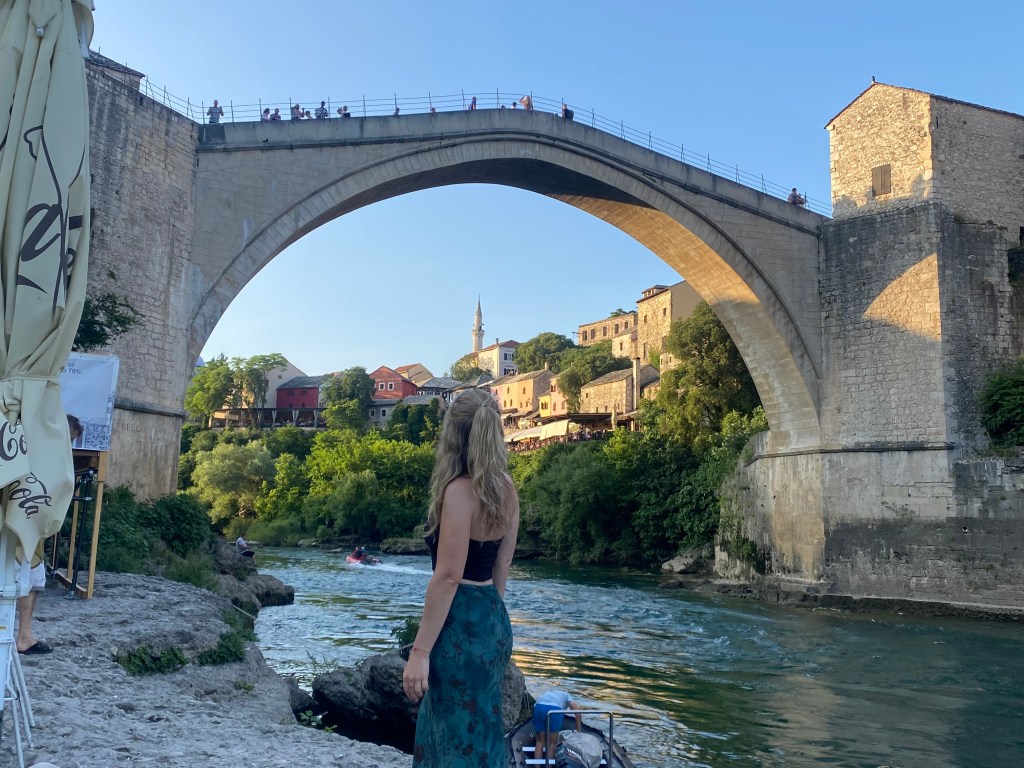
If you’ve seen a photo of Mostar before, then it’s highly likely that the Stari Most bridge featured in that photo. Completed in 1567 and destroyed in 1993 when it was hit by over 60 shells during the war, reconstruction of the now UNESCO protected bridge was finalised in 2004.
Described by 17th-century Ottoman explorer Evliya Çelebi as “a rainbow arch soaring up to the skies, extending from one cliff to the other”, the bridge is a focal point to the city and attracts trained jumpers who dive off into the cold waters below. We met one of these divers who was preparing to jump, but unfortunately couldn’t stay to see him leap.
Full day trip
The evening we arrived in Mostar, we wandered around and saw numerous tour operators selling the same thing: a full day tour of this part of Bosnia. We picked iHouse Travel’s Herzegovina tour on the spot for the next morning.
The first stop was Blagaj Tekke, an ancient Islamic monastery. After wandering around the grounds and purchasing a pot of shiny red cherries, we took a quick boat ride into a cave within the spring of the River Buna, the second largest source of drinking water in Europe.
Next on our tour was Žitomislići, a 16th-century Christian Orthodox church, destroyed in the war and rebuilt in 2003. Inside, it is awash with colourful, vibrant frescoes, and was a delight to visit. We also stopped off at Počitelj, an authentic Bosnian citadel which we climbed to enjoy sweeping views of the ancient streets below.

Kravice Waterfalls
The final stop on our day trip was to the incredible Kravice Waterfalls, one of Bosnia’s most beautiful natural wonders and my favourite place on our whole trip. Even though it was a lively weekend full of people, we found a quiet pocket in which to take advantage of the waterfalls away from the crowds. We dipped in the clear waters of the Trebižat River and soaked up the views as the cascades crashed around us.

Dinner with a view
Upon returning from our day tour, we wanted to have a special dinner as our last in the country. There are many beautiful spots overlooking the river and bridge, and we opted to try Terrace Lagero which had great food reviews and views to match. I would highly recommend booking beforehand, especially if it’s a weekend, and I did so on their Instagram just a few hours before. Enjoying a sunset dinner and wine with Stari Most behind me and the Koski Mehmed-Pasha Mosque’s minaret in front as the murmur of restaurant-goer’s voices mingled with the call to prayer was a sublime way to end our last evening in Bosnia.
Wandering and exploring
Mostar’s old town is filled with winding alleyways dotted with market stalls, little shops and local restaurants. During peak season you might struggle to walk without bumping into anyone, but taking a morning to explore the streets and stop off for a traditional Bosnian coffee is a great way to absorb the atmosphere. You could even take a speedboat ride along the river, which we wanted to do but ran out of time.
Plenty of looks of confusion met my gaze when I told people of my Bosnia trip before I left, yet on my return, about three of those mentioned that they have now added the country to their list of places to visit – a decision I fully support.
Words and photos by Alice Bzowska (apart from the one of me – thanks Tiddy!).



 Alice World Travels
Leave a comment